
Athletes train to perform. Most leaders just perform.
A senior leader performs every hour of every day, and trains almost never. That gap is the quiet reason so many capable leaders plateau.
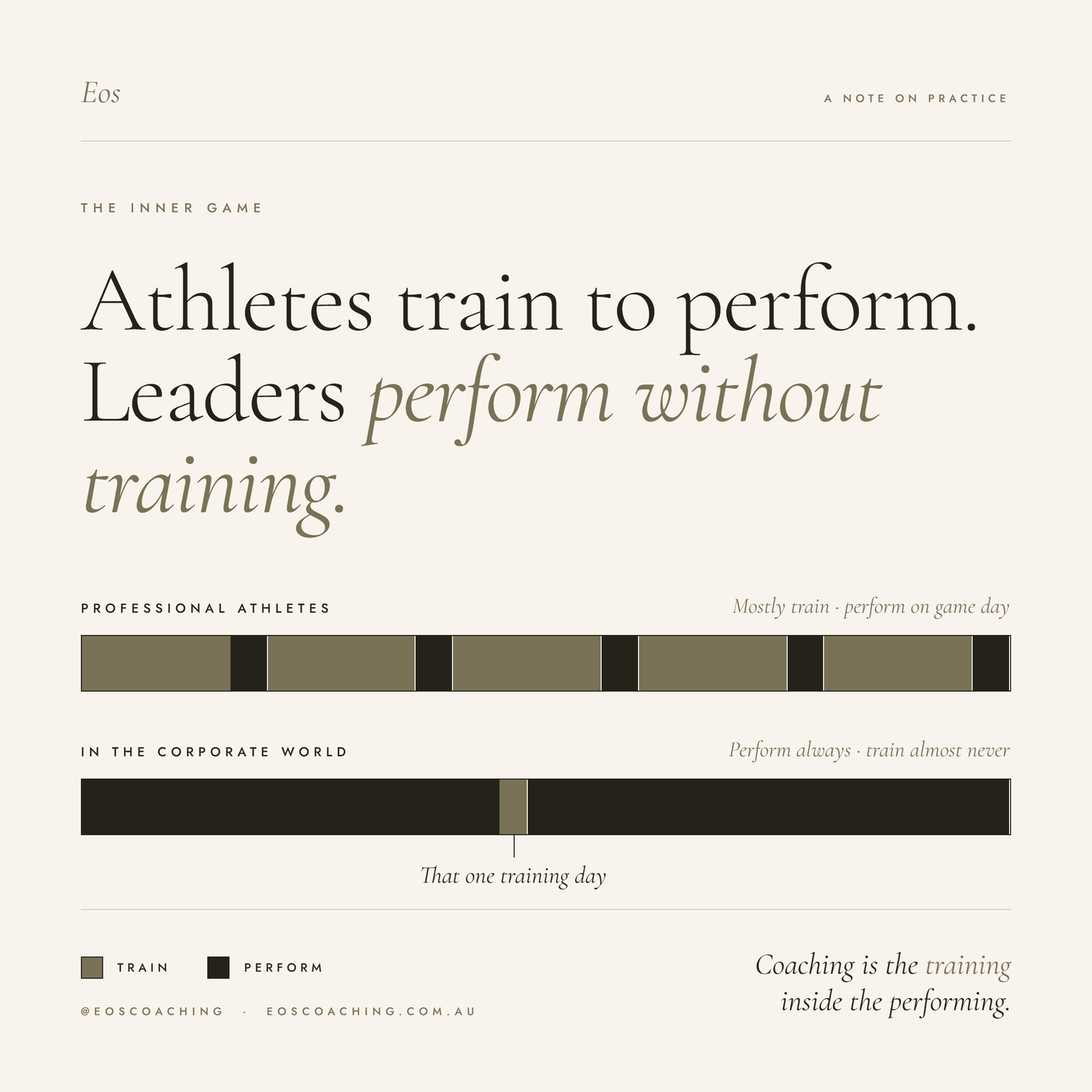
An athlete spends most of their week training and a fraction of it competing. A senior leader does the opposite: they perform every hour of every day, and train almost never. That gap is the quiet reason so many capable leaders plateau.
Watch how a professional athlete spends their week. The overwhelming majority of it is training. Drills, review, recovery, feedback, refinement. The actual performance, the game, is a thin sliver at the end. They earn the performance with everything that comes before it.
Now look at how a senior leader spends theirs. The performance is constant. Every meeting, every decision, every difficult conversation is game day. And the training? For most leaders it is one offsite a year, maybe a course, maybe a book on the bedside table they keep meaning to finish.
Perform always. Train almost never.
Why this happens
It is not that leaders are unwilling to train. It is that the system they operate in has no room built in for it.
An athlete’s calendar protects training time, because everyone understands that the performance depends on it. Nobody asks a sprinter to race every day and wonders why their times are slipping. But a leader’s calendar protects nothing of the kind. The diary fills with performance, back to back, and the idea of carving out time to actually work on how they lead can feel almost indulgent.
So the training quietly disappears. And because leaders are capable, they get away with it for a long time. They perform on instinct, on experience, on the patterns that have always worked.
The problem is not that they stop performing. It is that they stop getting better.
What “training” actually means for a leader
When I say training, I do not mean another framework or a workshop on a Tuesday. I mean something closer to what an athlete means by it.
Training is the deliberate, unhurried work on the things that decide how you perform. How you think under pressure. How you hold a difficult conversation without it holding you. The patterns you fall into when the stakes are high, and the ones you want to fall into instead. The decisions you keep rewriting at 4am, and the steadier place you could be making them from.
None of that gets worked on during the performance. There is no time. You are too busy leading. It gets worked on in the same way an athlete works on their craft: in a protected space, with someone watching closely, with honest feedback, repeated often enough to change the pattern rather than just name it.
Coaching is the training that lives inside the performing.
The cost of performing without training
A leader who only ever performs does not fail dramatically. That is what makes this so easy to ignore. They keep delivering. The results keep coming.
But three things happen slowly.
The patterns harden.
Whatever you did under pressure last year, you will do again this year, only more so. Without training, there is no mechanism to change it. The reactive response, the certainty that closes down the room, the tendency to carry it all alone: these do not soften on their own. They calcify.
The growth flattens.
Performance on instinct can carry you a long way, but it has a ceiling. The leaders who keep getting better are the ones who keep training, long after they have stopped having to. The ones who stop training keep performing at the same level and mistake the consistency for mastery.
The depletion builds.
Performing constantly, with no time to train, recover, or reflect, is exhausting in a way that hides itself. It does not feel like burnout until it does. Athletes understand recovery is part of training. Most leaders treat the absence of recovery as a badge.
What changes when you build the training in
The leaders I work with who perform most consistently are, without exception, the ones who have stopped treating training as optional.
They have built a protected hour into their fortnight that is not for performing. It is for working on how they lead. It is unhurried, it is honest, and it is entirely theirs. And what they notice, often within a few months, is that the performance starts to take care of itself. The decisions get clearer. The conversations get easier. The 4am rewrites get quieter.
Not because they learned a new technique. Because they finally gave the most important part of their leadership the one thing it had never had: time to train.
A final thought
You would never expect an athlete to perform at their peak with no training behind it. We understand, instinctively, that performance is earned in the hours nobody sees.
Leadership is no different. The only difference is that nobody schedules the training for you, and the performance never stops to let you.
That is the work. Building the training back into a life that is all performance.
It is learnable, and it is quieter and simpler than most leaders expect.

If you are performing constantly and rarely getting the chance to train, that is exactly the work I do.
Eos is a private leadership coaching practice in Newcastle, working with senior leaders across Australia. I read every message myself.